Arcane
- 1 д
- 7 д
- 30 д


On Arrakis you get caught in two ways, and the anti-cheat is only the first. The client is protected by kernel-level checks that start before the game does. The second way is people: the Deep Desert is open PvP, clips get recorded there, and guilds keep informal lists of players who find spice stockpiles a little too confidently and shoot a little too well from an ornithopter.
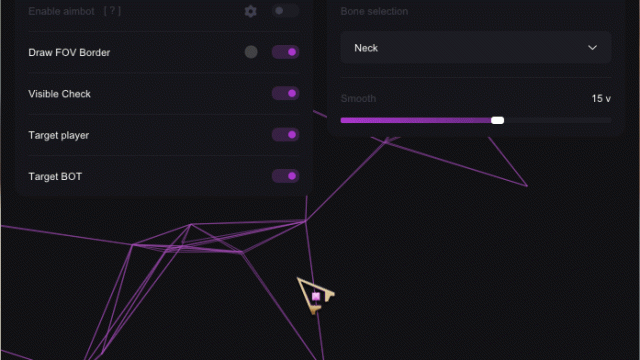
That shapes the settings. Detection range is worth keeping inside what binoculars and flight altitude could plausibly explain. Arriving at a spice blow before anyone else, or harvesting one alone next to a rival war party, is recorded by witnesses far more reliably than by any telemetry. Worms matter too — they answer vibration, and a player sprinting across open sand with no fear of them looks wrong to everyone watching.
Only then is it worth discussing features. Player and vehicle awareness, markers on resource nodes and fortifications, and help in shield-heavy firefights are what actually save a run. The weekly rhythm also suits access: a Coriolis storm redraws the Deep Desert completely, so seven days line up neatly with one full season of that map.
Almost always through behaviour rather than technical evidence. A player keeps arriving at the exact right coordinates, routes around guild patrols without ever meeting one, and cracks a stockpile nobody advertised. All of that gets recorded and discussed publicly long before a ticket is filed. Blending into normal behaviour matters more than which features are on.
The Coriolis storm redraws the Deep Desert and moves points of interest, but it changes the map rather than the client, so the build itself keeps working. What resets is your route knowledge. The timing is convenient: a week of access matches one full map cycle, which is roughly one complete season of spice runs.
Environmental dangers exist as objects, so an approaching worm, a storm front and aggressive wildlife appear in general awareness. It does not exempt you from the rules of Arrakis: you still need to reach rock, and your stillsuit still needs water. What you gain is a few seconds of reaction time, not immunity to the desert itself.
Yes, mostly through layout information. You can see how many defenders are inside, which floors they hold, and where generators and storage sit, which stops you spending explosives and time on empty walls. The siege itself stays slow — shields, structure tiers and tool limits are unchanged, so preparation still decides the outcome.
Useful, but differently. In PvE areas the value is gathering speed: markers on ore, wrecks and water sources cut the hours that exploration normally eats. Salvage detection matters too, since wrecked machinery feeds most of your early equipment. Risk is lower there simply because no rival is standing nearby with a recording key bound.