
Four different people buy PUBG software, and they want four different things. The first lands at the Pochinki school because that is where the action is, and is back in the lobby ninety seconds later without ever seeing who shot him. He does not need wins yet. He needs to survive into the second circle and learn how a mid-range fight actually works.
The second is returning after a long break. Rondo did not exist last time he played, weapon balance has shifted twice, and ranked matchmaking keeps pairing him with people who never stopped. The third has no time: one hour on a weeknight, and he refuses to spend it on dry drops with no loot. The fourth is chasing weapon levels and Survival Mastery, where progress is counted in hundreds of hours.
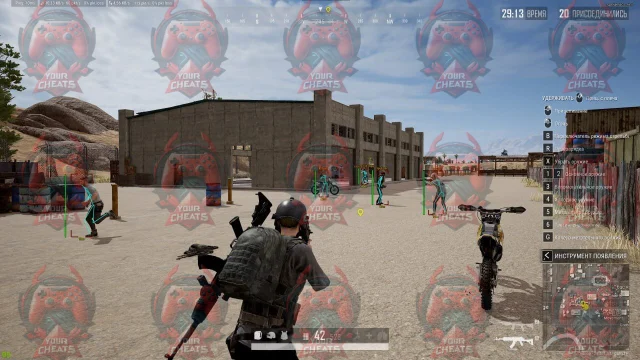
Those goals call for different tools. A beginner mainly needs to know who is nearby and where the blue zone is heading. A returning player gets more out of recoil control and bullet drop compensation, because rounds here travel slowly and fall, and an 8x scope alone does not fix that. Time-poor players want to read loot and vehicles before committing to a drop. Collectors want steady point income without losing the match in the first thirty seconds.
Частые вопросы про читы для PUBG
What protects PUBG on PC?
BattlEye runs on the PC client, but it is not the only layer. A large share of decisions is made server-side from statistics: headshot ratio, how fast the crosshair settles, accuracy at ranges where accuracy should drop. Player reports add a second path, since match replays are available to participants and clipped moments are what usually reaches moderation.
Should settings differ between FPP and TPP lobbies?
They should. Third-person play is built on peeking from cover, where you already see the enemy before he sees you, so aggressive snapping stands out immediately. First-person duels are shorter and decided in the opening frames, which is why FPP setups usually favour smoothing and a tight capture radius over long-range highlighting.
Does it really help at long range?
That is the main reason people run it on Erangel and Miramar. Bullets take real time to arrive and drop over distance, so a four-hundred-metre hit needs both vertical compensation and lead on a moving target. Calculating that removes most of the guesswork, but recoil still exists and a prone or supported position still matters.
How does this affect ranked points?
PUBG ranked weighs placement more heavily than kills, and early deaths subtract points outright. Survival is therefore where software changes the outcome most: spotting a squad rotating toward you is worth more than three opportunistic kills. Higher divisions also mean more attentive opponents, so moderate settings age better than maximum ones.
Is any map or the training range excluded?
Nothing is map-specific. Erangel, Miramar, Sanhok, Taego, Deston and Rondo all behave the same way, including the rotating map pool in matchmaking. The training range is useful for dialling sensitivity and watching how tracking behaves without risk, but there are no live opponents and no real ping there, so final values get tuned in actual matches.